
Cost-effective and customizable Barium sulfate 7727-43-7 factory
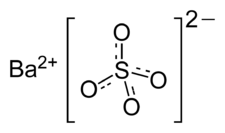
- Molecular Formula:BaSO4
- Molecular Weight:233.40
- Appearance/Colour:white powder
- Melting Point:1580oC
- Boiling Point:330 °C at 760 mmHg
- Density:4.5
Barium sulfate(Cas 7727-43-7) Usage
|
Medical Use and Risks
|
Radiographic Examination: Commonly used to radiographically examine the intestines and improve visualization by opacifying areas of interest fluoroscopically. Administration: Can be given orally or rectally for imaging purposes. Historical Context: Used in the early twentieth century as a substitute for a prior mixture called 鈥淩ieder meal.鈥? Risks: Potential risks associated with barium enema include colonic perforation, fecal impaction, and constipation. Generally excreted in feces without complication, but may traverse colonic mucosa in cases of preexisting mucosal damage. |
|
Industrial Importance
|
Composition: Barium sulfate (BaSO4) is composed of the barium cation (Ba2+) and the sulfate anion (SO42鈭?). Synthesis: Liquid-phase synthesis with subsequent precipitation is convenient due to the very low solubility of barium sulfate. Control of reagent mixing is crucial to prevent uncontrolled crystal growth. Deposition Issues: Barium sulfate deposition is a serious problem in flow assurance issues in various industries, with deposition occurring in two phases: the growth phase and the steady-state phase. |
|
Toxicology and Safety
|
Unabsorbed Nature: Barium sulfate used for medical purposes remains essentially unabsorbed and is unlikely to cause adverse effects. Antagonistic Effect: Barium acts as a physiological antagonist of potassium by blocking passive efflux potassium channels, leading to extracellular hypokalemia. Symptoms of Poisoning: Acute barium poisoning symptoms include gastrointestinal, cardiac, and skeletomuscular stimulation followed by paralysis in severe cases. Treatment: Potassium infusion and soluble sulfates are effective antidotes for barium poisoning. Inhalation of barium sulfate dust causes benign pneumoconiosis ("baritosis") with no impairment of pulmonary function. Minimal Toxicity of Nanoparticles: Inhaled barium sulfate nanoparticles are cleared quickly from the lungs in rats and cause minimal pulmonary response and no systemic toxicity. |
|
Safety Profile
|
Questionable carcinogen withexperimental tumorigenic data. Mutation data reported. Arelatively insoluble salt used as an opaque medium inradiography. Soluble impurities can lead to toxic reactions.Heating with aluminum can produce an explosion.Incomp |
InChI:InChI=1/Ba.H2O4S.2H/c;1-5(2,3)4;;/h;(H2,1,2,3,4);;/p-2/rBaH2.H2O4S/c;1-5(2,3)4/h1H2;(H2,1,2,3,4)/p-2